Why was the warranty claim rejected?
This example is deliberately compound. It asks EKA to combine structured operational evidence with document knowledge, without confusing them.
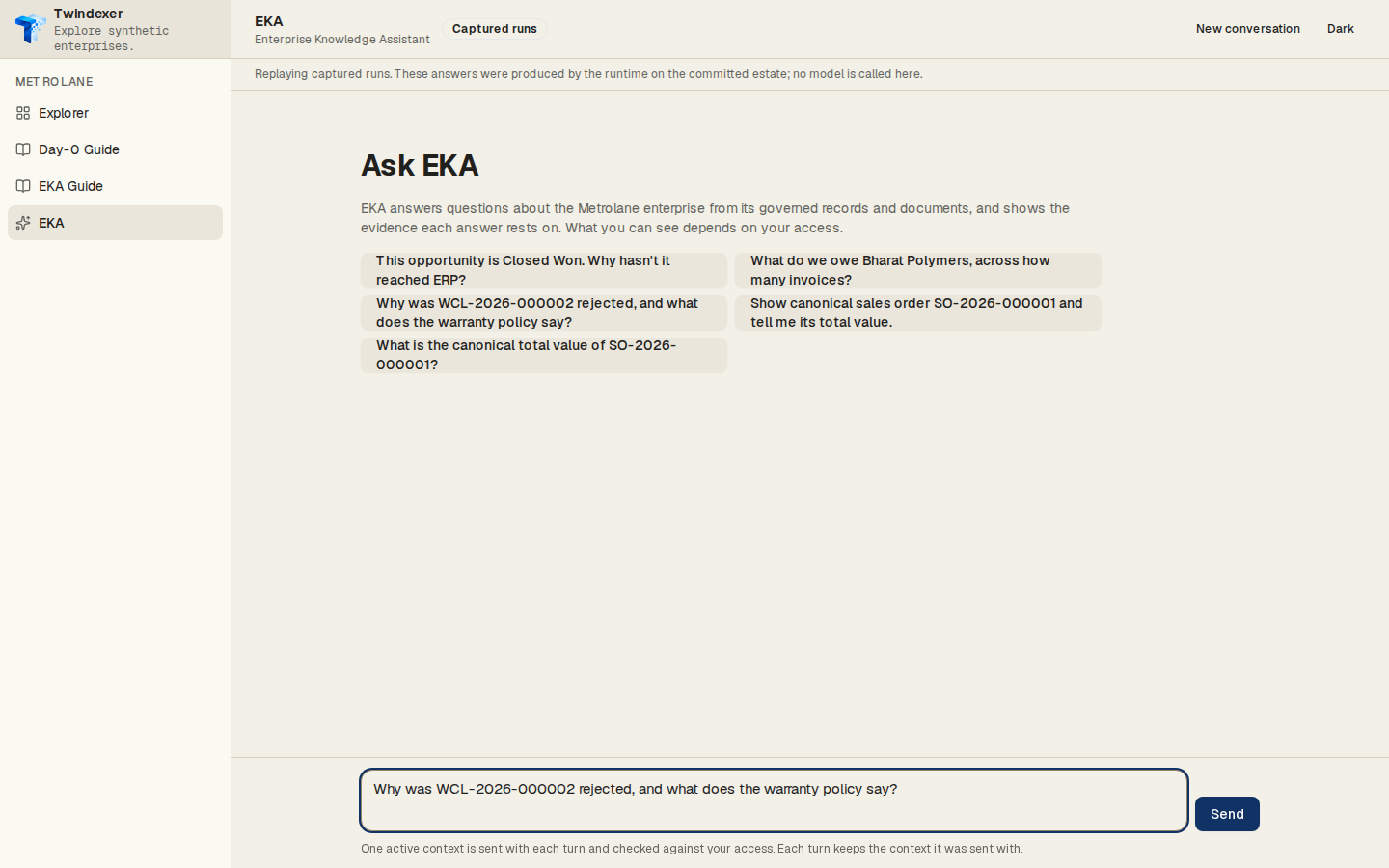
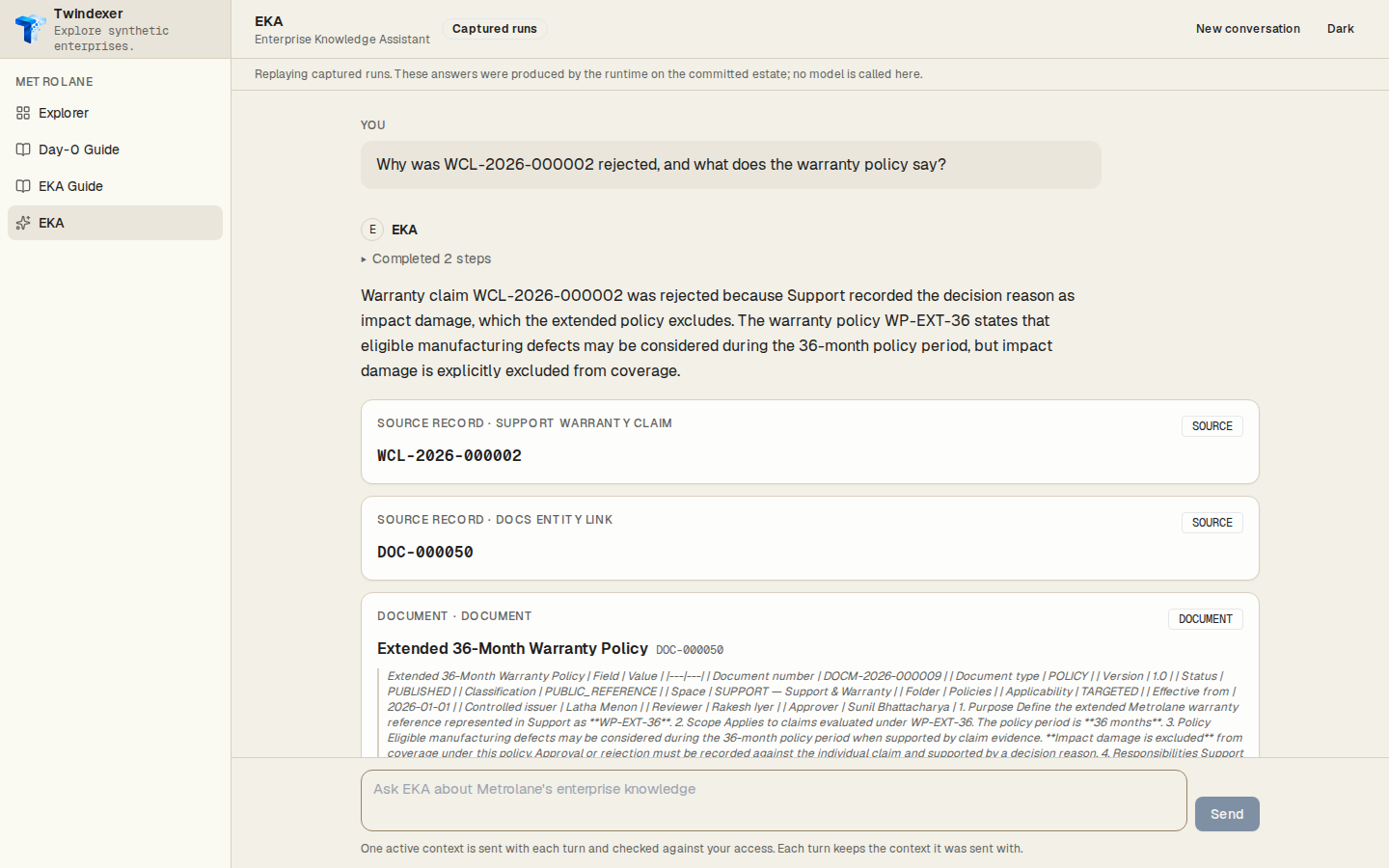
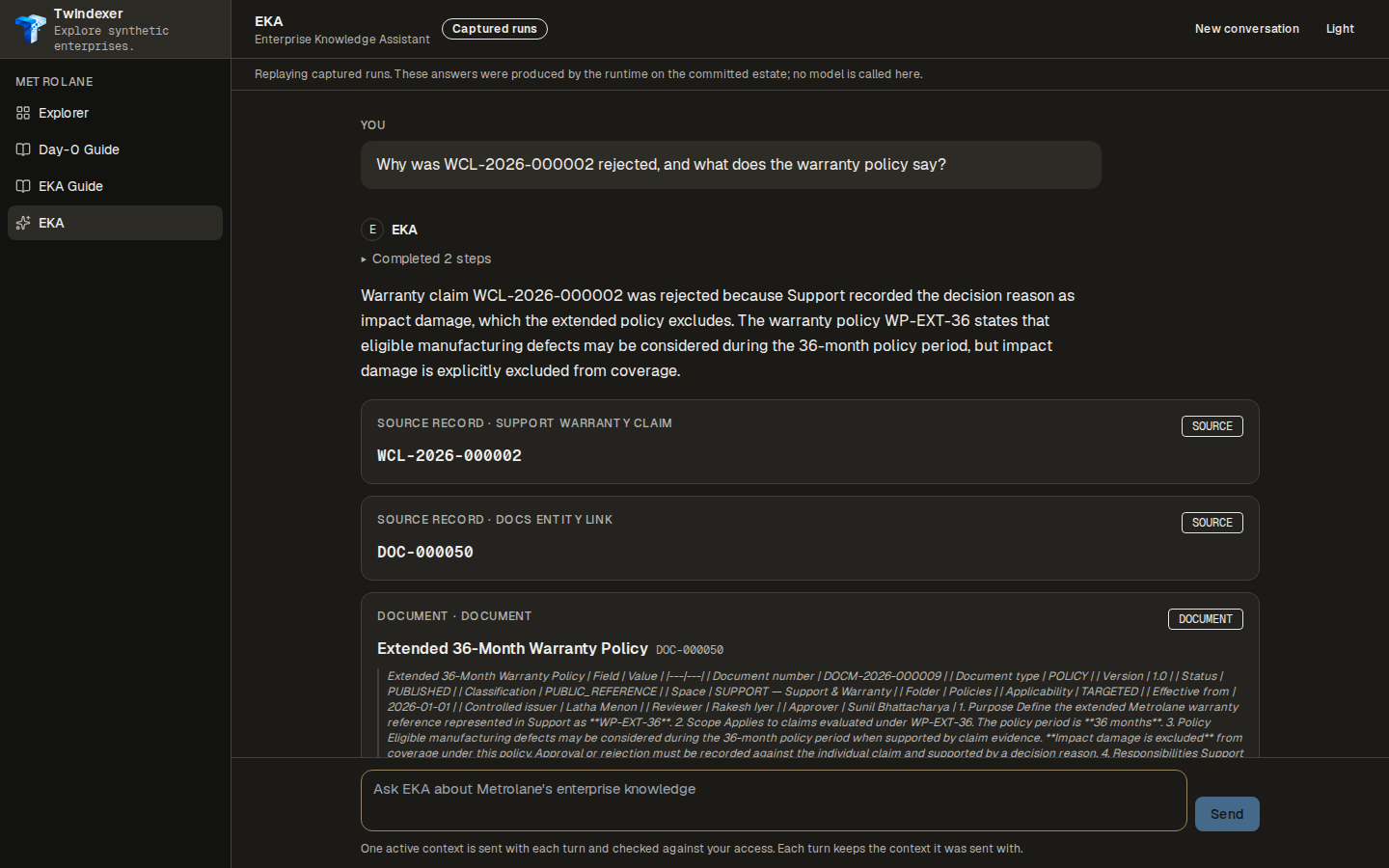
Why was WCL-2026-000002 rejected, and what does the warranty policy say?
- Result
- COMPLETE
- Tool calls
- 2
- Evidence
- 7
- Duration
- 6.5s
The user is asking two things about warranty claim WCL-2026-000002: why it was rejected, and what its warranty policy says. To answer why it was rejected, we need the warranty decision and reason using get_warranty_decision. To answer what the policy says, we must first retrieve the governing documents from the warranty decision tool and then search those documents using search_documents.
Step 1
get_warranty_decision(WCL-2026-000002)
→ claim state
→ customer claim_reason
→ Support decision + decision_reason
→ policy key
→ governing document key

Step 2
search_documents(
  query = "warranty policy terms conditions rejection coverage",
  document = governing document from Step 1
)
→ retrieve what the actual governing policy says
Step 2 names its document by reference to Step 1 ($s1.governing_documents.0) and declares that dependency, so the runtime accepted the plan on its first round. The policy text is read from the one document the Documents system records as governing the claim's policy, never from a guess at its title.
What the customer reported
claim_reason = "Bracket bent after a kerb strike."
What Support recorded as its decision reason
decision_reason = "Impact damage, which the extended policy excludes."
What the governing policy says
WP-EXT-36 governed by DOC-000050 Extended 36-Month Warranty Policy
This is labelled alternate authority, not silent substitution.
The document-search runtime also records a caution: retrieval relevance is not confidence. A top-ranked passage may still fail to answer the question. In this run the governing document was identified first, the search was scoped to it (1 readable document), and the passage returned opens with the document-control header and continues into the policy text itself.
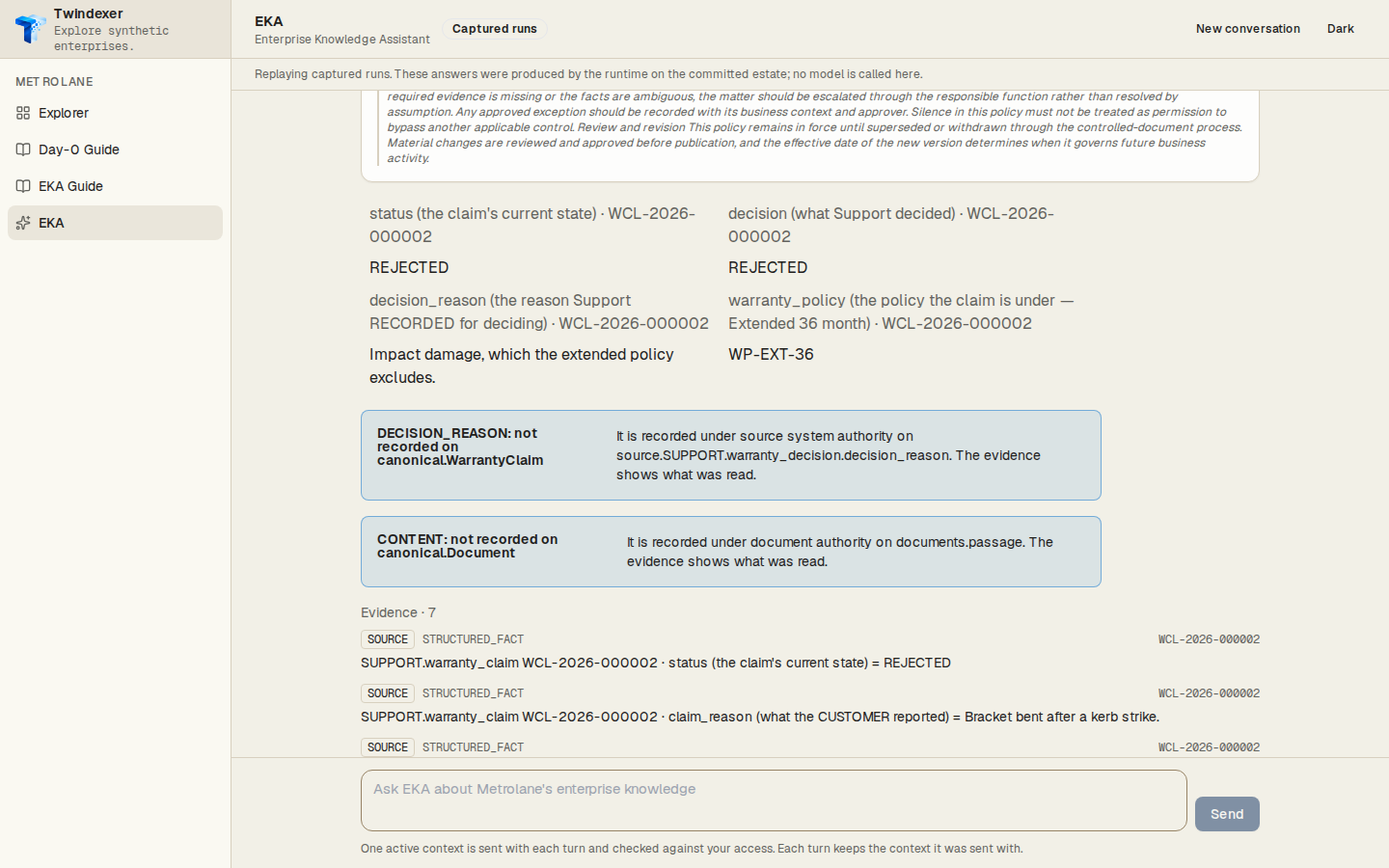
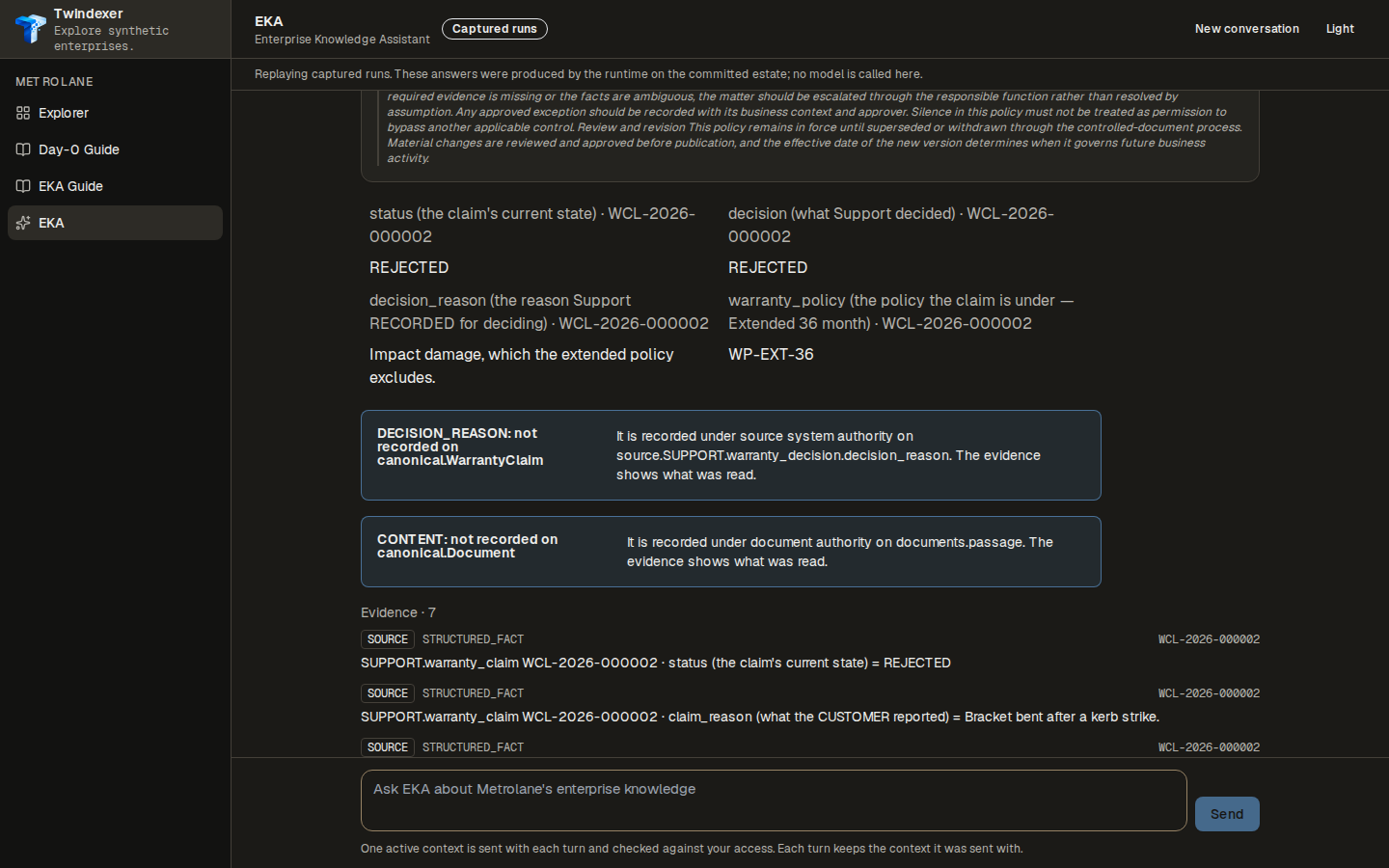
SUPPORT.warranty_claim WCL-2026-000002: status (the claim's current state) = "REJECTED".
claim_reason (what the CUSTOMER reported) = "Bracket bent after a kerb strike."
decision (what Support decided) = "REJECTED".
decision_reason (the reason Support RECORDED for deciding) = "Impact damage, which the extended policy excludes."
warranty_policy (the policy the claim is under — Extended 36 month) = "WP-EXT-36".
DOCS.entity_link DOC-000050: GOVERNS (the document the Documents system records as governing WP-EXT-36) = "DOC-000050".
Extended 36-Month Warranty Policy (DOC-000050) — document number DOCM-2026-000009, document type POLICY.
Warranty claim WCL-2026-000002 has a status and decision of REJECTED.
ESTABLISHEDEVD-FACT-46ad7869, EVD-FACT-169ded77
The recorded decision reason for the rejection is impact damage, which the extended policy excludes.
ESTABLISHEDEVD-FACT-f41fc62a
The claim is under warranty policy WP-EXT-36, which has a 36-month policy period and excludes impact damage from coverage.
ESTABLISHEDEVD-FACT-3d3ebd31, EVD-DOC-c0fd0755
The claim was rejected because the recorded decision reason of impact damage falls under the policy exclusion.
ESTABLISHEDEVD-FACT-f41fc62a, EVD-DOC-c0fd0755
customer claim reason ≠ recorded decision reason ≠ policy text
COMPLETE
Both user-requested parts were fulfilled: why it was rejected, from the recorded SOURCE decision reason; and what the policy says, from a DOCUMENT passage in DOC-000050.
Warranty claim WCL-2026-000002 was rejected because Support recorded the decision reason as impact damage, which the extended policy excludes. The warranty policy WP-EXT-36 states that eligible manufacturing defects may be considered during the 36-month policy period, but impact damage is explicitly excluded from coverage.
Warranty claim WCL-2026-000002 was rejected. The reason Support recorded for the decision is “Impact damage, which the extended policy excludes.” The governing 36-month warranty policy says eligible manufacturing defects may be considered when supported by claim evidence, while impact damage is excluded from coverage.
The guide then separately exposes the customer's own claim reason, so a reader can see that EKA did not confuse the reported event with the recorded decision reason. The run issued that fact as evidence (EVD-FACT-1570031f) and made no claim from it; its causal claim rests on the recorded decision reason and the policy passage. That claim is shown as the run made it, and the guide reads it no further than its two evidence items go: the recorded reason names impact damage, and the policy excludes impact damage. Neither record states on its own that the exclusion is why the claim was rejected, so the reviewed wording reports the recorded reason rather than a cause.
A simple retrieval assistant could search a policy and generate a plausible explanation.
EKA must preserve what the customer said, what Support decided, why Support recorded that decision, and what the policy says — and attach each statement to its own authority.
- Run ID
- RUN-0cdc10d1-1605-485a-af86-451821df9a01
- Result
- COMPLETE
- Model
- google:gemini-3.5-flash-lite
- Prompt
- PROMPT-EKA-0.4.6
- Planner hash
- 0fb08227cf1e04d7…
- Synthesis hash
- 2e56d7b0237722db…
- Build
- 093d195bbb15…
- Business now
- 2026-07-31 18:30:00+00
- Tool calls
- 2
- Evidence items
- 7
- Model calls
- 2
- Duration
- 6.5s
The EKA Workspace replaying this chapter's own captured run. No model is called in replay: what is on screen is the run described above, as the runtime returned it.
Transcript
- The question is typed and sent:
Why was WCL-2026-000002 rejected, and what does the warranty policy say?
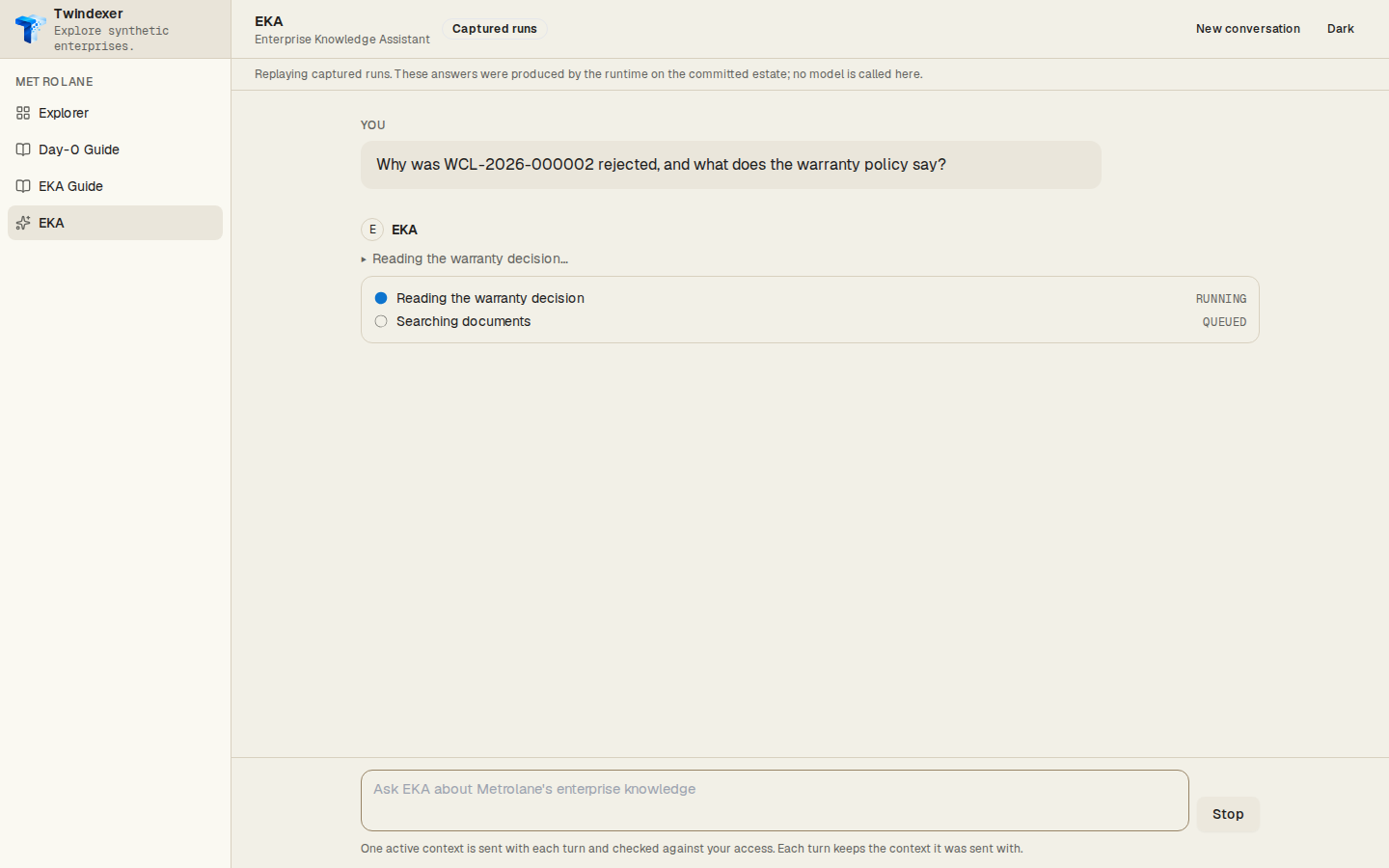
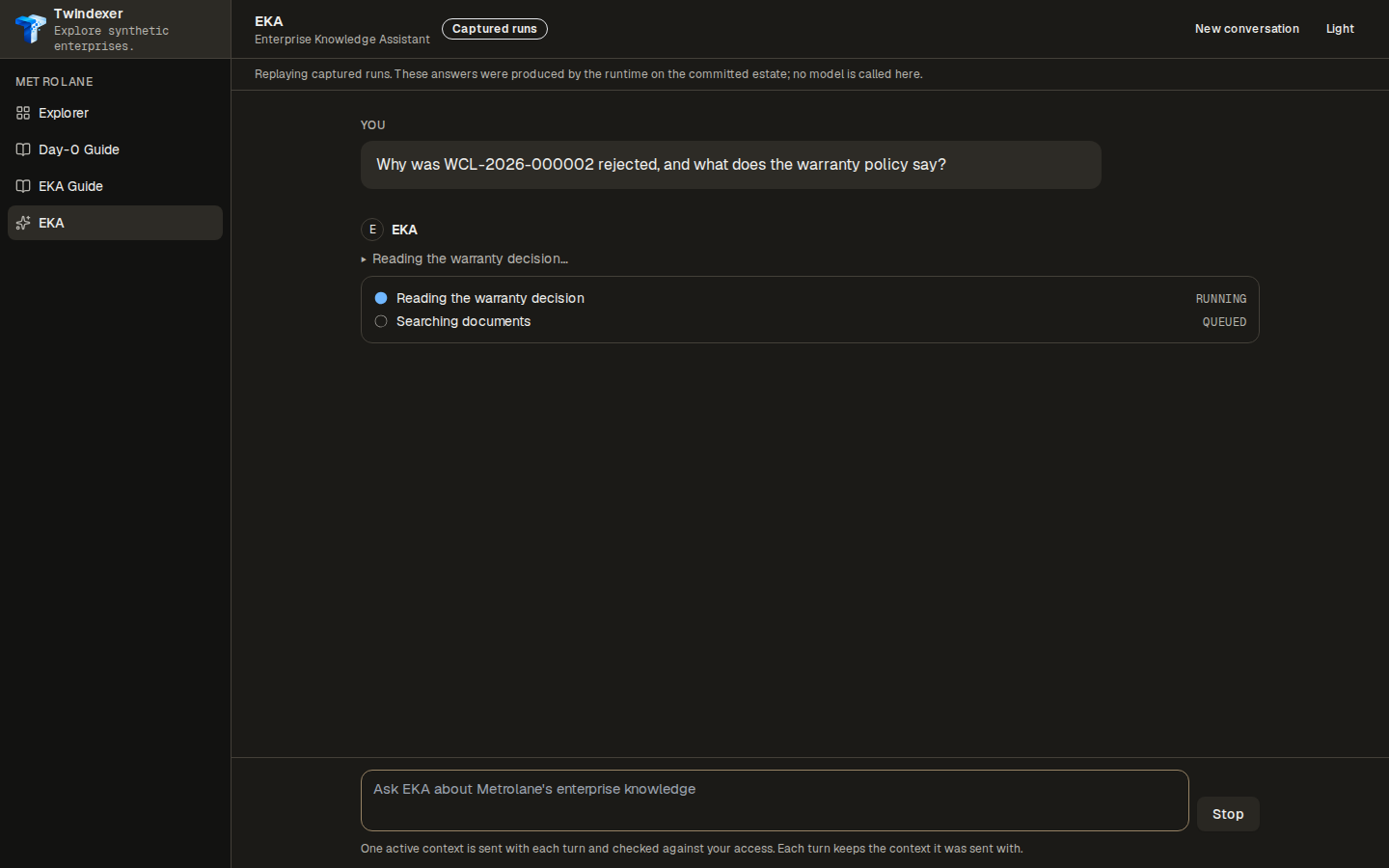
- The activity rail runs, then the answer arrives with its result: COMPLETE.
- The answer reads:
Warranty claim WCL-2026-000002 was rejected because Support recorded the decision reason as impact damage, which the extended policy excludes. The warranty policy WP-EXT-36 states that eligible manufacturing defects may be considered during the 36-month policy period, but impact damage is explicitly excluded from coverage.
- The steps are opened: Reading the warranty decision · Searching documents · Writing the answer.
- The evidence is opened: 7 items.
- The view returns to the answer.